# Cellular Curl Noise
Menu Path : **Operator > Noise > Cellular Curl Noise**
The **Cellular Curl Noise** Operator allows you to sample a noise value within a specified range in two or three dimensions based on provided coordinates. Cellular curl noise uses similar math to the [Cellular Noise](Operator-Cellular-Noise.md) Operator, but with the addition of a curl function which allows it to generate a turbulent noise. This noise is incompressible (divergence-free), which means that particles cannot converge to sink points where they get stuck.
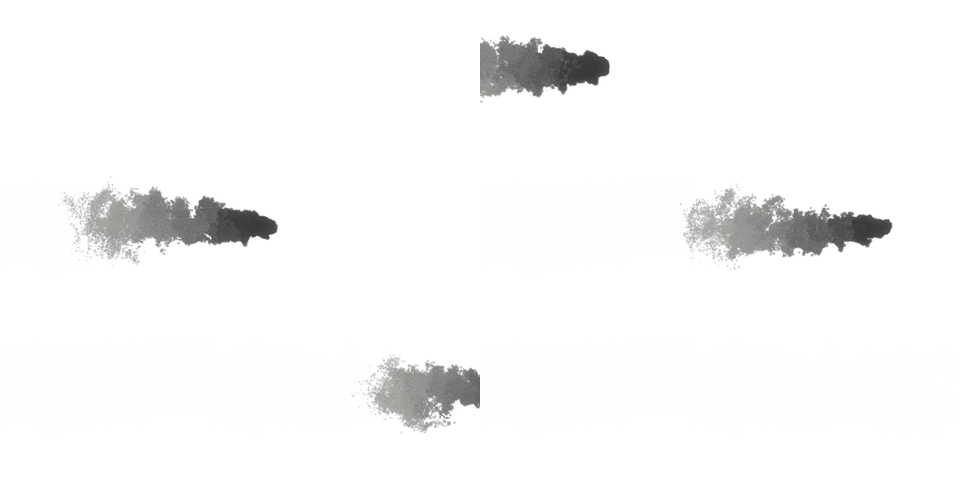
A good use case for Curl Noise is to simulate fluids or gas, without having to perform complex calculations.
## Operator settings
| **Property** | **Type** | **Description** |
| -------------- | -------- | ------------------------------------------------------------ |
| **Dimensions** | Enum | Specify whether the noise is two, or three dimensional. |
| **Type** | Enum | Specify what type of noise to use. |
## Operator properties
| **Input** | **Type** | **Description** |
| -------------- | ----------------------------- | ------------------------------------------------------------ |
| **Coordinate** | Float
Vector2
Vector3 | The coordinate in the noise field to sample from.

The **Type** changes to match the number of **Dimensions**. |
| **Frequency** | Float | The period in which Unity samples the noise. A higher frequency results in more frequent noise change.
 |
| **Octaves** | Int | The number of layers of noise. More octaves create a more varied look but are also more resource-intensive to calculate.
 |
| **Roughness** | Float | The scaling factor Unity applies to each octave. Unity only uses roughness when **Octaves** is set to a value higher than 1.
 |
| **Lacunarity** | Float | The rate of change of the frequency for each successive octave. A lacunarity value of 1 results in each octave having the same frequency.
 |
| **Amplitude** | Float | The magnitude of the noise. A higher value increases the range of values the **Noise** port can return.
 |
| **Output** | **Type** | **Description** |
| ---------- | -------- | ---------------------------------------------- |
| **Noise** | Float | The noise value at the coordinate you specify. |